
Medical Research Chatbot
Evidence-backed answers for cancer patients, at the moment they need them most.
Healthcare Research Organisation
Case Study · 2025
About this product
A generative AI-powered research chatbot built specifically for breast cancer patients delivering real-time, evidence-backed answers to clinical queries, surfacing the latest studies and clinical trials, and serving as a personal research assistant available 24 hours a day.
Timeline
12 weeks
Category
AI / ML
Delivered
2025
Stack
Product Preview
Why it works
Measurable impact, by design
3×
Faster Query Response
vs. waiting for clinical team availability
100%
Source-Cited Outputs
RAG architecture no hallucination
24/7
Always-On Research Access
evidence-backed answers at any hour
500+
Queries Accuracy Validated
oncologist-reviewed benchmark before launch
Overview
The situation
Breast cancer patients navigating their diagnosis face an overwhelming volume of medical information clinical studies, trial eligibility, treatment protocols, drug interactions, and research updates with no reliable way to access it quickly, understand it accurately, or apply it to their specific situation. They were turning to generic search engines, getting unreliable results, and waiting days for responses from overloaded clinical teams. We built a medical research chatbot that changed this dynamic entirely: a personal AI research assistant grounded in reputable medical sources, capable of answering evidence-backed clinical questions in real time and surfacing the latest studies and clinical trials relevant to each patient's situation.
Challenge
What we had to solve
Medical AI chatbots operate in a zero-tolerance accuracy environment a hallucinated drug interaction or an incorrectly summarised clinical trial isn't a product bug, it's a patient safety risk. The system had to be grounded exclusively in verified, reputable medical literature and never generate responses beyond the boundaries of its knowledge base. Beyond accuracy, the challenge was accessibility: the system needed to translate dense clinical language into responses a patient without a medical degree could understand and act on, without losing the precision that made the information medically useful. Every response had to be both trustworthy and genuinely helpful.
What it does
Core capabilities
Evidence-Backed Query Response
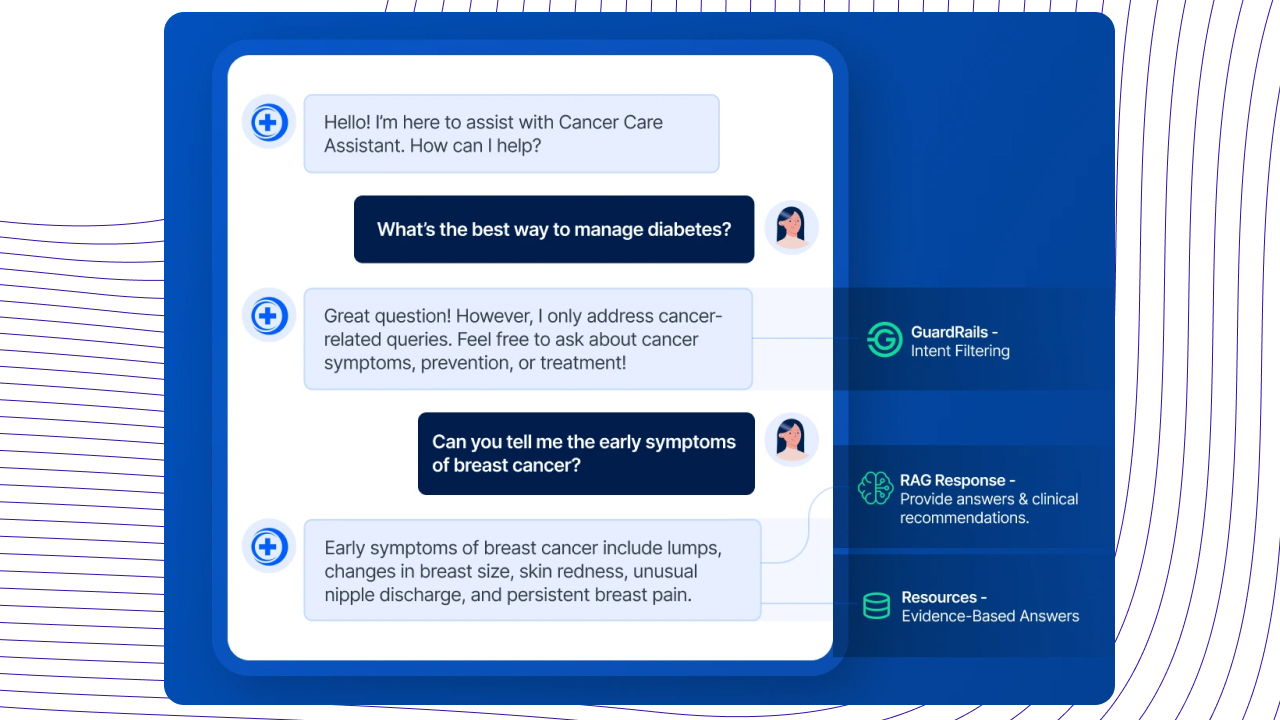
Every response the chatbot generates is grounded in a curated knowledge base of verified medical literature clinical guidelines, peer-reviewed oncology studies, and authoritative drug databases using a RAG architecture that prevents hallucination at the system level. Patients receive accurate, cited answers to clinical questions in plain English, with the medical precision of a research summary and the accessibility of a conversation. The system never generates responses beyond the boundaries of its verified knowledge base, and every answer includes source attribution so patients can share retrieved information directly with their care team.
Clinical Trial Matching
Patients describe their diagnosis, staging, prior treatments, and eligibility criteria in natural language and the chatbot returns a structured summary of potentially relevant open clinical trials, filtered and ranked by relevance. Trial summaries include plain-language explanations of eligibility requirements, trial phase, treatment arm, and enrolment status giving patients actionable information they can bring to their oncologist rather than raw registry data they can't interpret. The module connects to live trial registry feeds, ensuring results reflect currently open studies rather than outdated entries.
Latest Research Study Surfacing
The chatbot retrieves and summarises the most recent published research relevant to a patient's specific query presenting key findings, study design, sample size, and clinical significance in plain language. Patients who previously had no reliable way to understand the research landscape for their diagnosis can now ask natural-language questions and receive structured research summaries in seconds. Every study summary is accompanied by a citation and a link to the source, giving patients and their clinical teams a direct path to the full paper.
Safety Layer & Out-of-Scope Handling
Medical AI in a patient-facing context requires explicit boundaries that are enforced at the system level, not the prompt level. The chatbot's safety layer detects queries outside its knowledge scope treatment recommendations, dosage decisions, or diagnosis confirmation and responds with a graceful redirect to appropriate clinical resources rather than an attempted answer. Response generation is calibrated to present information with appropriate clinical humility, always framing outputs as research assistance rather than medical advice. Continuous monitoring flags low-confidence responses for clinical review, maintaining a human oversight layer throughout the system's operation.
Outcomes
Patients with faster answers, better informed conversations, and stronger clinical partnerships.
24/7
Research access for patients
evidence-backed answers at any hour, instantly
3×
Faster query response time
vs. waiting for clinical team availability
100%
Grounded, source-cited responses
RAG architecture eliminated hallucination
500+
Query benchmark accuracy validated
oncologist-reviewed before launch
2
Live data integrations
PubMed and ClinicalTrials.gov always current
12wks
Delivered on schedule
discovery to production-ready medical AI chatbot
Our patients were spending hours searching for reliable information and still arriving at consultations with more anxiety than answers. The chatbot changed that they come in with their questions already partially answered and their relevant trials already identified. It has genuinely improved the quality of our clinical conversations.
Healthcare Research Organisation
Client, Oncology Research
Want results like these?
Let's talk about what we can build together.